


Select subsidiary

You are attached to the subsidiary: France

Languages available

Maximizing MEWP battery lifespan: Essential tips for peak performance and safety

Energy and power management remain a core challenge for site and fleet managers. Anticipation is just as critical to job site success as maintaining proper storage and recharging routines. Today, advanced telematics systems allow fleet managers to monitor and evaluate battery health across every phase of machine operation and charging. Regardless of the Mobile Elevating Work Platform (MEWP) deployed on your site, total confidence in battery reliability is essential. Understanding battery state-of-charge limits and operational parameters drastically boosts overall machine efficiency and performance.
Maintenance

Understanding the primary causes of battery wear

Batteries are engineered to deliver high efficiency, ease of charging, and resilience against everyday use. However, understanding underlying electrochemical processes is vital for proper care, maintenance, and monitoring. Haulotte technical experts highlight three primary causes of premature battery failure: 
  • Poor storage habits. 
  • Inappropriate charging routines. 
  • Lack of proper water refilling. 

Proven charging habits for extended battery life

Predicting exact battery lifespan is complex due to varying applications, usage frequencies, and maintenance regimes. The simplest foundational rule is maintaining a high state of charge for as long as possible. Maintaining batteries above 70 percent State of Charge (SOC) significantly minimizes sulfation and optimizes operational longevity. Never store a MEWP with a deeply discharged battery, as this severely impairs performance and accelerates sulfation. 

Implement these five essential charging practices:

Post-shift Recharge

Recharge the machine after each daily shift to prevent improper charging frequencies from degrading chemical components.

Low SOC limit (20%)

Initiate a recharge before the SOC drops below 20% to avoid deep discharges that encourage harmful sulfation.

Weekly full charge (100%)

Perform a full recharge reaching 100% SOC at least once a week without cutting the cycle short.

Approved charging profile

Always adhere to the manufacturer's recommended charging curve and use approved chargers tailored to the specific battery model and ambient temperatures.

Equalization phase (Every 7 Cycles)

Conduct an equalization phase every 7 full charges (excluding AGM or GEL batteries) by leaving the machine plugged in for an additional three hours to restore original capacity levels.


Additionally, combatting natural sulfation, the formation of lead sulfate crystals on battery plates, requires scheduling a desulfation cycle (using ultra-slow charging or negative pulse modes) every six months.

Safe storage protocols and temperature management

Proper storage requires fully charged batteries and routine monthly maintenance. Because batteries undergo natural self-discharge during storage, specific gravity or voltage must be checked every 4 to 6 weeks, paired with a monthly full charge. 
 
Ambient temperature plays a decisive role in battery behavior. Operating batteries in temperatures below 27°C (80°F) reduces output capacity (delivering roughly 50% capacity at -18°C/0°F). Conversely, operating above 27°C (80°F) increases temporary output but accelerates wear and shortens overall lifespan. Elevated temperatures speed up self-discharge rates, and charging should never occur at temperatures exceeding 49°C (120°F). In freezing conditions, keeping the MEWP plugged in when idle is strongly advised. General rule: a 10°C (50°F) rise in temperature cuts battery life in half. 

Follow these five steps for successful equipment and battery storage:

Step 1: Power disconnection

Disconnect the main power circuit plug in accordance with local regulations and wearing appropriate personal protective equipment.

Step 2: Terminal inspection

Inspect battery terminals to ensure a complete absence of oxidation.

Step 3: Cable security

Verify that all cable terminals are tightly secured to the battery posts.

Step 4: Pre-shutdown charge

Perform a complete charge prior to shutting down equipment storage.

Step 5: Electrolyte level top-up

Inspect fluid levels and top up to recommended levels using deionized or distilled water.


Upon taking equipment out of storage, reconnect the main power circuit plug and execute a full recharge before deployment.

Water management for lead-acid batteries

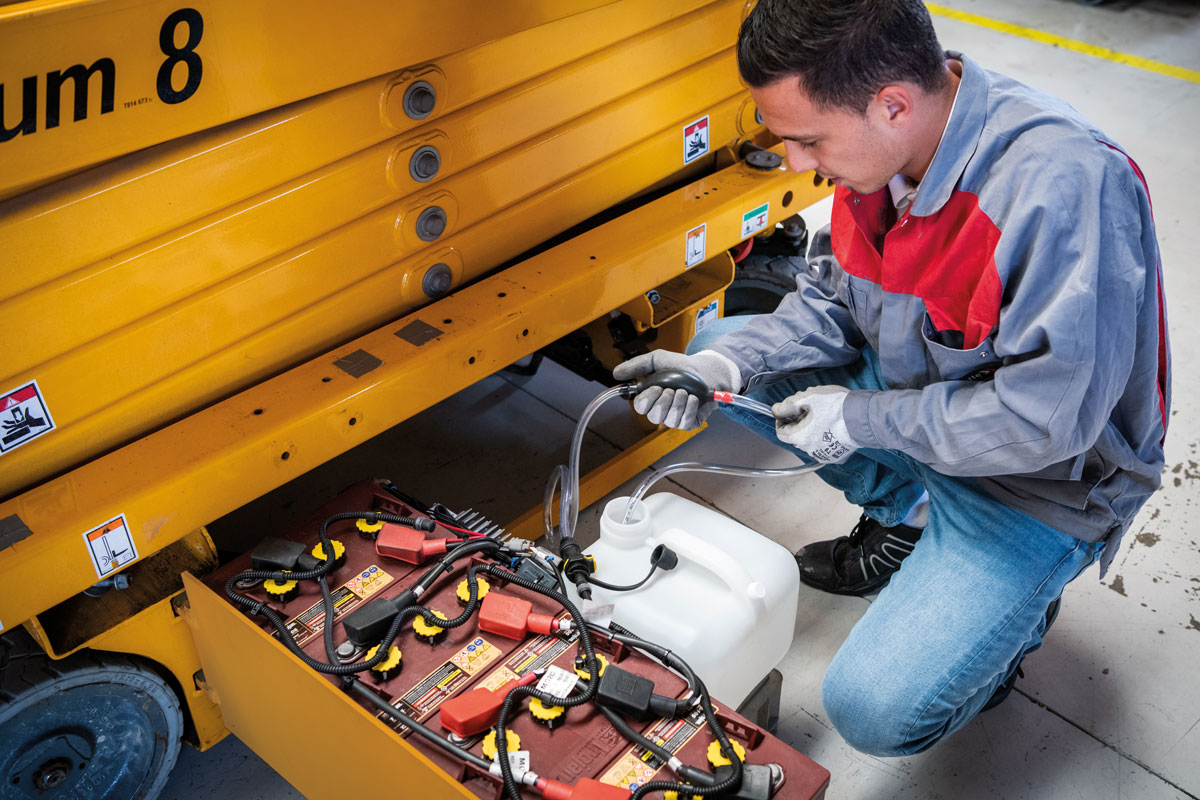
Lead-acid batteries rely on a precise balance of water and acid. Energy replenishment processes cause natural water loss over time. Allowing electrolyte levels to drop below the top of the internal plates causes irreversible structural damage. Inspecting fluid levels twice a month and refilling when necessary is mandatory. Refilling should take place immediately following a full electric recharge, allowing the naturally expanding acid volume to remain safely within design limits without overflowing. 
Tap water introduces harmful minerals and contaminants and must never be used. Always utilize deionized or distilled water sourced according to manufacturer specifications. 
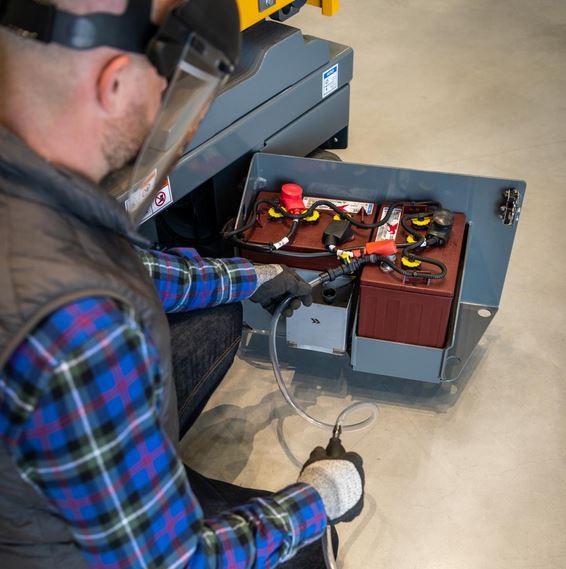
Maintenance technician checking MEWP battery using proper safety equipment.
options_4_AEM
20210106_haulotte-battery-care-vertical-masts
💡 Haulotte Expertise

Activ'Energy Management & Sherpal

To eliminate complexities associated with battery upkeep, Haulotte engineered Activ'Energy Management (AEM).

Activ'Energy Management (AEM)

This intelligent technology pairs smart chargers with automated water-refilling solutions to slash maintenance requirements and replacement costs. The system governs all charging parameters while incorporating dedicated maintenance cycles like equalization and desulfation.

Sherpal telematics integration

Combined with Sherpal telematics, fleet managers can remotely track, communicate, and diagnose battery fault codes in real-time through the MyHaulotte portal.

Safety focus: Handling hazards and compliance

Battery maintenance involves working with electrical circuits and chemical solutions, demanding rigorous safety precautions:
  • Mandatory Personal Protective Equipment (PPE): Always wear chemical-resistant gloves, eye protection, and appropriate workwear when handling battery fluids or performing maintenance. 
  • Electrical isolation: Always isolate power circuits before disconnecting cables or performing terminal inspections to prevent arcing or short-circuits. 
  • Regulatory alignment: Ensure all maintenance procedures comply with local labor laws and standard operating safety guidelines.

 

Proactive battery management is the cornerstone of reliable MEWP operations. By establishing rigorous charging routines, respecting temperature thresholds, and leveraging smart technologies like Haulotte AEM and Sherpal, fleet managers ensure maximum equipment availability and long-term asset value.

Ready to optimize your fleet's energy performance? Contact your local Haulotte representative to learn more about our advanced charging and telematics solutions.

ISO Certified 9001/14001/45001

Global solutions provider

Blue company challenger

Experience maker